
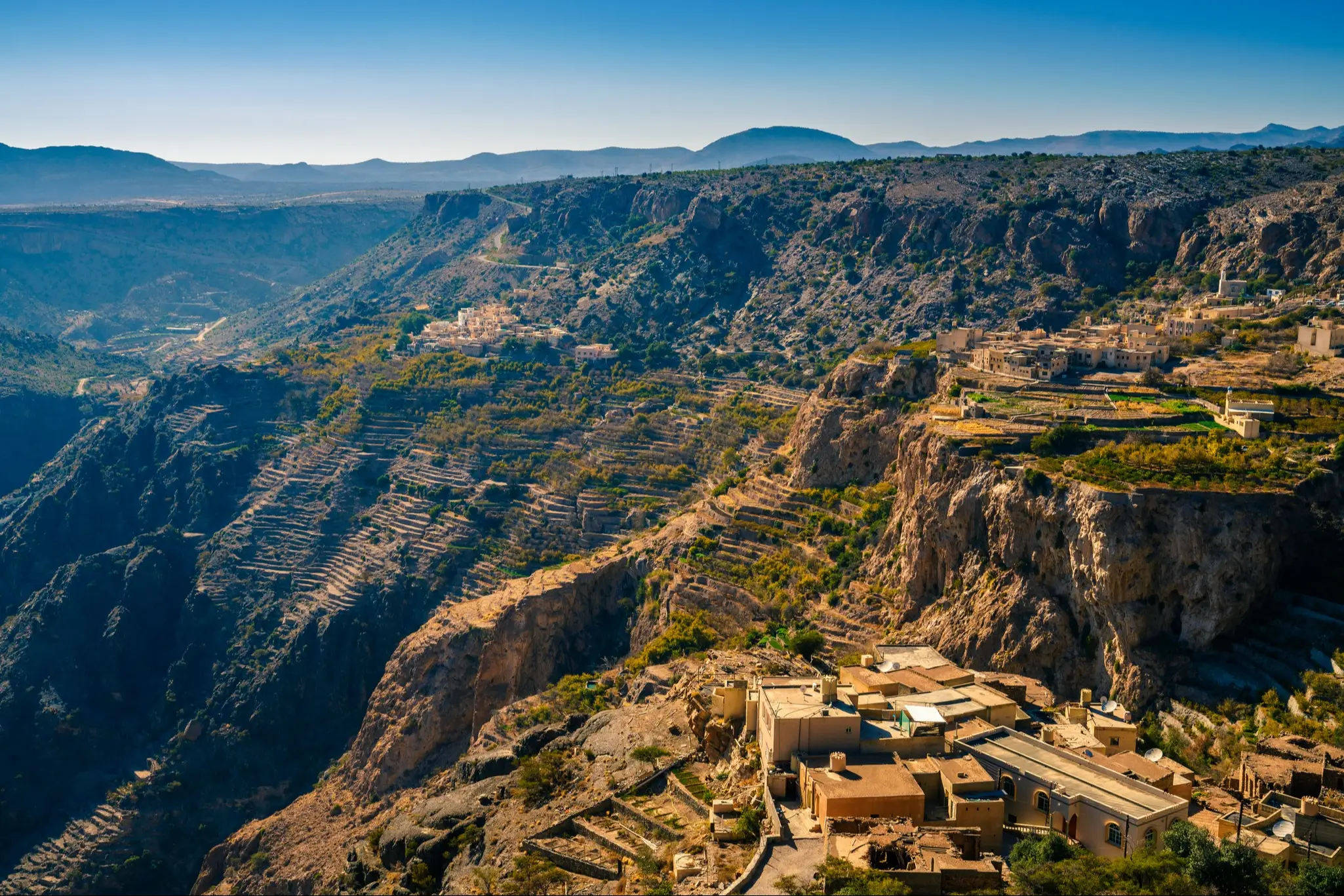
Jebel Akhdar Tour From Muscat
Visitor Guide

Jebel Akhdar Things to Do

Oman's Green Mountain rises to roughly 2,000 metres above the Ad-Dakhiliyah desert floor, and the plateau at its summit runs on a rhythm nothing like the coast below. This jebel akhdar things to do guide sets out what the mountain actually offers, when it is accessible, and what the drive up demands before you commit a day to it.

7 min read Updated 2026-08-17 Fact-checked
Jebel Akhdar Things to Do

Quick answer

Jebel Akhdar is open 00:00–23:59, seven days a week, with entry set at 0 OMR. The plateau itself never closes, but practical access is governed by the mandatory mountain checkpoint at the base, where a 4WD vehicle is required. Plan around a 06:00–10:00 arrival window; the address for navigation is Saiq Plateau, Al Hajar Mountains, Ad-Dakhiliyah Governorate, Oman.

The roses of Jebel Akhdar bloom for roughly three weeks a year. For the remaining eleven months, the terraces that produce Oman's most prized rosewater sit as bare stone shelves cut into the mountainside — a reminder that this plateau is a working agricultural landscape first and a visitor destination second. Understanding that ordering explains most of what surprises people about jebel akhdar things to do: the pomegranate orchards, apricot trees and walnut groves are private smallholdings, tended by families from villages whose falaj irrigation channels have carried snowmelt and spring water along the same gradients for centuries. What a visitor is dealing with, then, is not a single site with a gate and a queue but a dispersed plateau at around 2,000 metres, roughly two hours from Muscat by road, where the attractions are villages, ridgelines, farm terraces and the abandoned settlements clinging beneath them. Saiq and Sayq form the administrative centre. Al Ayn, Al Aqr and Ash Sharayjah are the three terraced villages strung along the escarpment, connected by a walking route locals have used for generations and now signposted as a trail. Diana's Point, named after the Princess of Wales's 1986 visit, overlooks Wadi Al Ayn. Wadi Bani Habib holds the ruins of a stone village and a walnut grove in its floor. None of these charge admission, and none operate to a timetable. That freedom is precisely why planning matters more here than at a ticketed monument. Because the plateau has no closing hour, the real constraint is daylight, road condition and the checkpoint at the foot of the mountain road — a filter that turns away vehicles it judges unsuitable. Distances between villages are longer than a map suggests, gradients are severe, and mobile signal thins out along the escarpment paths. Anyone assembling a Jebel Akhdar itinerary from Muscat should treat the mountain as a full day rather than a stop, and build in the descent before dark. Used well, the answer to jebel akhdar things to do is a sequence rather than a list: reach the plateau early, walk one terraced route properly instead of driving past three, and let the afternoon go to a viewpoint. Detailed access requirements, seasonal timing, costs and the full set of Al Hajar Mountains landmarks are set out in the sections below.

“The plateau has no closing hour; the real constraint is daylight, road condition and the checkpoint at the foot of the mountain.”
Timing

The Best Time for Jebel Akhdar Things to Do

Jebel Akhdar maintains cooler temperatures than Muscat, making it accessible throughout the year. The best arrival window is 06:00–10:00 to avoid mid-day heat and ensure sufficient time to explore before sunset.

March to May

Moderate

Pleasant, 15°C to 25°C

The rose harvest occurs in April, attracting many visitors to the terraced gardens.

September to November

Low

Mild, 12°C to 22°C

The pomegranate harvest season offers clear skies and comfortable hiking conditions.

June to August

High

Warm, 20°C to 30°C

While hotter than winter, these months remain significantly cooler than the coast.

Weekday mornings

Low

Early arrivals provide quieter access to local trails and vantage points.

Verdict: Plan your visit for weekday mornings between March and May or September and November, arriving between 06:00 and 10:00.

Directions

Essential Transport for Jebel Akhdar Things to Do

Jebel Akhdar is located on the Saiq Plateau within the Al Hajar Mountains, Ad-Dakhiliyah Governorate, Oman. Access is exclusively via a mountain road that requires a 4WD vehicle to pass the mandatory police checkpoint.

Car 2.5 hours

Route 15 from Muscat to Nizwa, then follow signs for Route 13 towards Jebel Akhdar

Car 45 min ascent

4WD vehicle required for ascent via Birkat Al Mouz

Ensure your vehicle is a 4WD, as local authorities strictly enforce this requirement at the checkpoint before allowing ascent. Inspect your brakes and cooling system before departing Muscat.

Prices

Admission Fees and Jebel Akhdar Things to Do

Access to the Jebel Akhdar region is free of charge for all visitors. Travelers are only required to ensure their vehicle meets safety standards for mountain transit.

Plateau Access Free public entry to the area
0 OMR
Mandatory Checkpoint Access 4WD vehicle required for compliance
0 OMR
Entry to the mountain plateau is free for all visitors regardless of age or residency.

Verdict: Adults pay 0 OMR for entry, though a 4WD vehicle is mandatory for passage through the mountain checkpoint.

What to see

Primary Jebel Akhdar Things to Do: Sightseeing and Landscapes

Jebel Akhdar is defined by its dramatic terraced agriculture and historical village architecture set against the rugged Al Hajar Mountains. Visitors can explore ancient water systems and cliffside paths that showcase the region's traditional cultivation methods.

Wadi Bani Habib

An abandoned village featuring traditional mud-brick houses and stone pathways set within a deep canyon. Walk down the restored stone stairs to observe the preserved dwellings.

Follow the path down from the parking area for canyon views.

Diana’s Point

A prominent lookout named after the late Princess of Wales who visited this vantage point in 1986. It offers expansive views over the terraced gardens and the valley below.

Visit during the morning light for clear photography conditions.

Al Ayn Terraces

Agricultural slopes carved into the mountainside, known for the seasonal cultivation of pomegranates, roses, and walnuts. These systems utilize the traditional aflaj irrigation channels.

Walk the perimeter trails to see the intricate irrigation channels.

Saiq Plateau

The central elevated area of the mountain range, serving as the primary hub for exploring local flora and village life. The plateau hosts various fruit orchards and rose plantations.

Park at the marked trailheads to explore the village outskirts.

Checklist

A Pre-Visit Checklist for Jebel Akhdar Things to Do

Work through this checklist in order, starting weeks ahead and finishing on the morning you set off for the Saiq Plateau.

Book

Check availability

Frequently asked

Frequently asked questions about jebel akhdar things to do

Everything you need to know about jebel akhdar things to do

What is the best way to plan my jebel akhdar things to do itinerary?

To organize your jebel akhdar things to do effectively, focus on the terraced farms and ancient villages located across the Al Hajar Mountains. Planning your route in advance helps ensure you cover the primary cultural landmarks while accounting for travel time from the capital. Exploring the highland plateau requires careful preparation to navigate the steep terrain safely. Always check current weather conditions before departing to ensure a smooth experience during your mountain exploration.

Keep reading

More guides & pages